Sunday, January 4, 2015

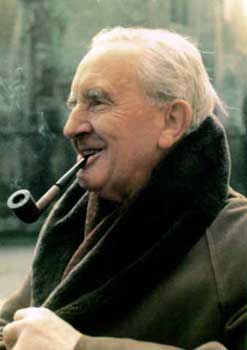
Virgil vs. J.R.R. Tolkien


Virgil:
Aeneas 
Virgil was an ancient Roman poet who wrote during the Augustan period. He wrote poems such as the Eclogues, the Georgics, and his famous epic poem the Aeneid. The Aeneid is seen as a national epic of ancient Roman times to modern day. The Aeneid is about Aeneas, who is a Trojan refugee destined to complete his mission to reach the shores of Italy. Aeneas has to leave his home and family behind in order to build a city there. More information about the Aeneid can be found here.

Virgil was a huge influence on many Western literature and most notably, Dante's Divine Comedy, were Virgil was Dante's guild through purgatory and hell. Virgil was considered the Roman national poet and the ultimate form of perfection in his art. He influenced writings like Edmund Spenser's The Faeric Queene and John Milton's Paradise Lost. He also influence John Dryden, Matthew Arnold and Alfred, and Lord Tennyson. There are also many similarities with Virgil's the Aeneid and J.R.R Tolkien's The Lord of the Rings.

Virgil 

J.R.R. Tolkien:
Tolkien was a poet, philosopher, and university professor who is best know for The Hobbit and The Lord of the Rings. Tolkien wrote during the modern era, but took influence from earlier poetry, languages, and  mythology. Modernism was a time when traditions, prior to WWII, were rejected and people wanted a new way of doing things. For writer this meant creating stories that were know and had never been told before. Tolkien did this by creating a fantasy land. He went in great detail in order to invite and allow his readers to visualize his words. Tolkien refrained from using words that were common among fantasy works, so that  the readers were truly experiencing something new and unlike anything they read before.

J.R.R Tolkien

My product is a comparison of Virgil's Aeneid and J.R.R. Tolkien's The Lord of the Rings writing.


Sources:
"Virgil." Virgil. N.p., n.d. Web. 02 Jan. 2015.
"Talking About Tolkien." Talking About Tolkien. N.p., n.d. Web. 02 Jan. 2015.


Negative Aspects of Roman Gods

Roman Gods are a group of higher beings that have reigned over the Roman people for centuries. Roman Gods have obvious flaws with in their system and flaws are what make this system of higher beings poor. For example The Roman god of war Mars is one primary source of foul behavior. He is a god who is famous for aggressive and violent out lashes, not to mention he is a god responsible for war. War ruins lives, families, and countries which Mars is responsible for all of this pain and suffering, and the worst thing is he is supposed to enjoy it the most. This God does not deliver any good to people only suffering, humans are better of with this god who is responsible for suffering.
Aside from the violent perpetrators there is also the leader of these gods, Jupiter. This God meddles in the affairs of the people quite often. He is widely accepted as the leader and the Greeks, although they call him Zeus, speak of him as a wild person. He often meddles in the affairs of humans on a daily basis, he has numerous affairs with endless woman, and is often feared for his anger as well. This is no idol for men to look upon, he is no model that others should strive to be. Gods are meant to be a goal to us humans, that one day we can hopefully reach, but this God is a model of what not to be. He cheats on his wife, and scorns all of the misfit children he is responsible for. He abuses his power more than any God which shows his carelessness and history has told us that he isn't even loyal to women so how should he be loyal to his supporters?
Lastly there is one more God to talk about, Minerva. This god is a cold and calculating person regarded as the wisest among the gods. Although she was wise she was brutal. There is a story that she saw a woman weave a beautiful piece, it was so beautiful that even Minerva couldn't find a fault in the work. Angered by this Minerva turned her into a spider in spite of her piece. Minerva is a cold  God who is absorbed in herself. She is not fit to rule men when she cares more for herself.

Works Cited
"Jupiter | Roman God." Encyclopedia Britannica Online. Encyclopedia Britannica, n.d. Web. 09 Jan. 2015.
"Roman Gods and Goddesses - Crystalinks." Roman Gods and Goddesses - Crystalinks. N.p., n.d. Web. 08 Jan. 2015.

Roman, Luke, and Monica Roman. Encyclopedia of Greek and Roman Mythology. New York: Facts On File, 2010. Web.

Link to product
https://docs.google.com/a/student.egsd.net/presentation/d/1gcASzrBI9YVhG2sxUUs3zxcaWPnaHMTeNey6kHNB3oo/edit

Tuesday, December 23, 2014

The Influence of Classical Literature of Virgil on Later Works of the Middle Ages and Renaissance


Virgil, one of the great poets of his time, has had a profound impact on many writers over the past two millennia since his death. His epic poem, the Aeneid, is considered to be one of the most important pieces of classical literature (Mackail).

A bust of Virgil in Naples
Virgil himself was influenced by the Greek poet Homer, and his works the Iliad and the Odyssey. The Aeneid is an epic poem that tells the story of Aeneas, a Trojan soldier who flees the city of Troy after it is destroyed by the Greeks during the Trojan War. Similar to the Odyssey, the Aeneid recounts “a series of Mediterranean adventures and an eventual homecoming, and is like the Iliad in recounting a war to capture a city,” (Cox).

However unlike Homer and many poets before him, Virgil could read and write. He didn’t hear the Homeric poems orally, he read them. This allowed him to consult Homer’s work while writing his own. Virgil chose to write his own story, based on Homer’s character of Aeneas, who was briefly described in the Iliad. He, like many Roman thinkers, adapted the philosophical ideas of the Greeks to apply to those of their own situation in the Roman republic and empire. 

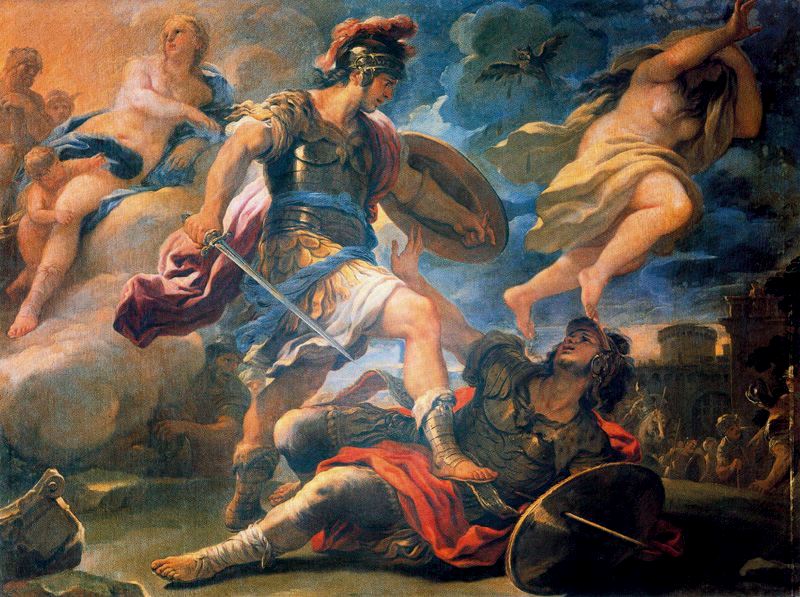
"Aeneas and Turnus" by Luca Giordano is a painting inspired by
the work of Virgil.
Soon after his death, his work was modelled by the poet Ovid. The writings of Virgil have been studied almost as long as the language of Latin itself. During the Middle Ages, many religious scholars interpreted his writings as Christian allegories, even though Virgil died decades before the idea of Christianity had even formed.  

These religious interpretations caused the work of Virgil to become widespread during this time, and became a huge influence on the work of Dante Alighieri in the 14th century. For those unfamiliar, the Divine Comedy is an epic poem, written in first person, as Dante travels through Hell, Purgatory, and Paradise. Dante’s Divine Comedy is considered to be the most important piece of literature composed in the Italian language (Scott). Virgil is even included as a character in the Divine Comedy, as he guides Dante through Hell and Purgatory.

Depiction of Satan by Gustave Dore was inspired by Satan
as description in Milton's Paradise Lost, which was
greatly influenced by Virgil.
During the Renaissance, Virgil’s work became the inspiration for John Milton’s Paradise Lost. Paradise Lost tells the story of the “Fall of Man”, as depicted in the Book of Genesis, the first book of the Old Testament. The Aeneid became the model for Paradise Lost in epic structure, but also writing style (Williams). 

Though Virgil’s influence waned during the Romantic period, as it was believed he lacked the emotion and sensitivity that blossomed during the early 19th century, his popularity once again soared during the Victorian era. Even today, the writings of Virgil, and those who came after him, are still an enormous influence on writers and philosophers alike. I have made a timeline to demonstrate the evolution of writers that Virgil has inspired over the last two thousand years.


Sources:

Cox, John D. "Introduction to Virgil, The Aeneid." Introduction to Virgil, The Aeneid. Hope College, n.d. Web. 12 Dec. 2014.

Mackail, J. W. Virgil and His Meaning to the World of To-day. New York: Cooper Square, 1963. Print.

Scott, John A. Understanding Dante. Notre Dame, IN: U of Notre Dame, 2004. Print.

Williams, Robert D. "Virgil." Britannica. Encyclopedia Britannica, 8 Jan. 2014. Web. 12 Dec. 2014.


Monday, December 22, 2014

Roman Mythology vs Greek Mythology

A main part of both ancient Greek and Roman civilizations was mythology. Mythology was used by these societies to explain world origins, life occurrences,  and many wonders of the world. Greek and Roman Mythology are very similar due to the fact that the Romans adopted most of the Greek's ideas. Greek mythology was created around 2000 BC,  hundreds of years before Roman mythology, which was estimated to be established during the 12th century BC (Delgado). Although the origin of Greek mythology is unknown, the god Timaus and goddess Critias are linked with many stories that involve the beginning of Greek mythology (Delgado). On the contrary, there is a Roman myths that tells of the creation of Rome. The more widely known myth is "Romulus and Remus" (Grant 98). Two twin brothers sent down a river in a basket and rescued by a she-wolf. The two boys grew up and decided to build a city and rule it as kings. They had a contest to decide who would be king, but when it seemed clear Remus would win, Romulus killed him and assumed the role as the first king of Rome. This was an important story to the Romans "since their city was started by the son of a god it had to be more powerful than any other city" (Garcia).
The picture above is of the infamous statue of the she-wolf suckling Romulus and Remus. A similar Greek myth is the one regarding the creation of Athens. The city, according to Greek Mythology,  was in contest between Athena and Poseidon about who would become the protector of the city. The myth details that Poseidon gave a spring with sea water, while Athena offered an olive tree. The people chose Athena hence the city having the name Athena. This myth is symbolic to the Greeks because the two gods symbolize the strength of Athens not only as a city of wisdom, but also as a sea power (Athens History).
The picture above is of Athena and the olive tree she gave to the city of Athens that supplied its people with food, oil, and wood. My product was to compare Roman Mythology and Greek Mythology and their founding stories. I used a prezi format for my product because I believe it shows the clear connections between Roman mythology and Greek mythology.
Prezi


Works Cited

"Athens History." History of Athens Greece a Brief Reference to Athens History. Ancient Greek 

Guide, n.d. Web. 22 Dec. 2014.

Delgado, Jose. "Roman Mythology vs. Greek Mythology." Kean.edu. N.p., n.d. Web. 22 Dec. 2014.

Donn, Linn. "Athena & Poseidon." Athena (Minerva). N.p., n.d. Web. 21 Dec. 2014.

Garcia, Brittany. "Romulus and Remus." Ancient History Encyclopedia. N.p., 4 Oct. 2013. Web. 

21 Dec. 2014.

Grant, Michael. Roman Myths. New York: Scribner, 1972. Print.

Graves, Robert. The Greek Myths. Baltimore: Penguin, 1955. Print.

K, Sai. "Myths and Legends." Greek Mythology vs. Roman Mythology. N.p., n.d. Web. 22 Dec. 2014.

Sunday, December 21, 2014

Roman Poetry(Virgil) vs Modern Poetry(Robert Frost)


Before I knew anything about the Ancient Roman poet Virgil, I read parts of his most famous poems which included The Georgics, The Eclogues, and the epic Aeneid in which was modeled after Homer's  Iliad and the Odyssey.  They confused me but I wanted to know more about him and his life so I could truly understand them and their meanings.  Virgil wrote poetry during the Augustan period and from 70 B.C.E. to 19.  He is considered one of the greatest poets thanks to what is considered the epic of his time (Aeneid).  This epic consists of 12 books which tells the journey of a young Aeneas who was considered to be Augustus or the ruler of the Roman Empire at the time.  Although this story was fictional, what made it so interesting was the connection to the current Roman Empire and its future.  The Aeneid also displayed some of Virgil’s feelings of the Empire at the time.  Overall what Virgil did was base his writing off some of the great poets including Theocritus and Homer and create great pieces of work that we remember and read today.  
Sculpture of Virgil in Naples

Today there are so many poems which makes it tough to find the best poets because they are very similar in the way they write, but particular poems stand out above others due to their meaning and importance.  One in particular that is a popular modern poem is the Road Not Taken by Robert Frost.  This in comparison to Virgil’s Aeneid is not as long, does not have as much depth, and word choice is totally different but the two both express an indirect point of view on life during each of their times. Virgil more so directed at leadership and an Empire while Frost shows a more personal life message.  In reality the two are almost completely different but what has not changed from Virgil’s time to Frost’s time is the goal of wanting to display an important message in life.  Robert Frost most likely did not consider the way Virgil wrote when he was writing the Road Not Taken, but Virgil has left a mark on modern poetry no doubt. 

Image result for robert frost


https://docs.google.com/a/egsd.net/document/d/1cgQoRVve67UPGZZc-D_P_2IOmwHsNb3Sgz8OhqFInE0/edit?usp=sharing
My product is comparison between Virgil's poems and Robert Frosts. How they relate but also how they differ.


Sources:

Poets.org. Academy of American Poets, n.d. Web. 21 Dec. 2014.

"The Road Not Taken - Poem by Robert Frost." The Road Not Taken - Poem by Robert Frost. N.p., n.d. Web. 18 Dec. 2014.

Caesar's War Tactics

Our overarching topic is the battle tactics employed by Julius Caesar. Within that, we also researched battle formations, combat styles, and strategies to steal supplies. War was an essential part of Julius Caesar's life including most notably the Gallic Wars. As we researched, it is clear that battle tactics in ancient Roman times greatly vary from those used today. Stealth and patience was not a main Roman tactic; common tactics for them included attacking the enemy head on and risking their lives much quicker. Had they waited and held back, rather than constantly sacrificing the front lines, lives could have potentially been saved. However, the Roman's had many battle formations used at the time to protect as many soldiers as possible. While such strategies would not be as effective in modern day, they seemed to have success during ancient times.

Battle tactics in Roman times
https://www.youtube.com/watch?v=qhSc_wIofyM
Battle tactics now
https://www.youtube.com/watch?v=2X3NwEAM8c4

There are five main Roman battlefield positions.

Wedge Formation: The Roman's had a  line of soldiers in the back row and a triangle formation in the front to provide concentration to the center in order to could smash through the enemy
Single Line Defense: This was simply an extended line of soldiers.
Cannae Tactic: The formation had a weak center on purpose so that all of the outside soldiers could attack.
Manniple Channels: The Roman's would leave room between rows of soldiers so the enemy would come through them and be surrounded by both sides.
Strong Right Flank: This formation focused on a strong right flank to concentrate on the enemy's left flank. The Roman's would then sneak and attack from the back.
Protected Flank: This strategy is different, as the army is psychically protected by a natural barrier, such as mountain's, rather than forming a human barrier.


Less popular formations include the following. 

Testudo (Turtle) Formation: Roman's would resemble a turtle-like form of protection, forming a square completely covered with shield both around and above. However, such a tight formation caused the soldier's to cover little ground. 

Orbis Formation: The soldier's would form a circle shape with shield covering all sides. At the center of the circle would be the officer, who was fully protected by outside soldiers. This was only used when soldiers were detached from a smaller unit or when encircled by the enemy.
There are three combat styles used depending on the situation. 

Hand to Hand: Hand to Hand contact was typically only used after the release of missile type weapons. During the chaos and damage that ensues after, such a strategy is less dangerous than had it been done during open fire. Such fighting also included the use of swords and shields. 
Acute Shock: This strategy entails fighting the enemy in short and painful bursts. Rather than quickly fighting until death, enemies would battle for a period of time and then draw back to collect themselves. As they waited, other soldiers repeated the same process. The idea was such a long process eventually becomes mentally and physically draining for the enemy. 
War Machines: This tactic relied on heavy firing of both machines and balls of fire. After the attack the Roman's would then advance forward in lines, continuing as each front line got taken down. Eventually, they would gain on the enemy. 


Roman's also had specific ways of stealing the enemies resources. They first strategy used would be to attack the enemy resource location and grab as many of their resources as they could. However, often times it was not this simple. Roman soldiers also had a way of intercepting enemy supplies while in transit. The soldiers would locate the enemy's main supply place and set up a stopping point, so when the enemy soldiers stopped, the Roman's would raid the supplies. Finally, the soldiers could resort to the most violent of strategies. The soldiers would surround a major supply place, such as a town, and cut off all outside contact. This eventually led to an enemy surrender. The Roman's would then quickly build a wall around the place to ensure security. From there, the enemies inside the walls would either surrender or be killed. 

Overall, the different strategies employed by Roman armies were very interesting. The most fascinating part of the Roman army was the neat and structured formations. To walk and approach the enemy while staying in formation and closing all gaps truly takes skill. Many of the strategies mentioned above were used by Caesar and his army during the Gallic Wars. For our product, Jen and I made a play book, further illustrating the purpose and details of each strategy. We discuss a major battle during the Gallic Wars that went wrong and "re-create" the battle using tactics that we have developed ourselves. While the tactics mentioned above show clear skill and thought, Jen and I have learned that all tactics can be improved, which is what our product shows. 

https://docs.google.com/a/student.egsd.net/document/d/14OdDjlaOO3saOdn0NdkrnhrgO2WgrfugXm-F4h1x8k8/edit


Sources 
Cavazzi, Franco. "The Orb." The Roman Empire. N.p., n.d. Web. 17 Dec. 2014.
Wilson, Andy. "The Romans." The Classics Pages. N.p., n.d. Web. 17 Dec. 2014.
Swain, George R. The Classic Journal. 2nd ed. Vol. 3. N.p.: n.p., n.d. Print.
"The War in Gaul." The Gallic Wars. N.p., 05 Oct. 2014. Web. 17 Dec. 2014.
Morris, Graham. "Julius Caesar, Man, Soldier and Tyrant." Battlefield Anomalies. N.p., 25 Mar. 2014.       Web. 17 Dec. 2014.


Caesar War Tactics

Formations:
Wedge- This tactic has thin lines that are used to break through the enemy lines. The shape is like a pyramid so the lines get increasingly longer as the lines go farther back.
Single Line Defense- soldiers are sent out in a single line to be able to overlap the enemy or meet a wider formation if they come across it.  
Cannae Tactic-The center is left weak to 'invite' the enemy into the middle. The surrounding flanks are stronger to surround the opposing army.
Zama Tactic-Channels are left between maniples to lead enemy war elephants away from heavy infantry. This is very dangerous because flanks are left vulnerable.
Strong Right Flank- Strength would be on the right flank in order to break the enemies left flank. The 'roll up line' would then attack the enemy from the rear.
Protected Flank-He would use a natural barrier to protect one side of the flank.
Mpl-frm-variations.png
Combats:
Hand to Hand- This occurred after the missiles were fired
The Acute Shock- bursts of shots to shock and scare the enemy
War Machines- Machines the threw rocks and balls of fire

Resource Tactics:
1. intercept supplies while they are in transit. find main supply place of enemy and make a stopping point so when the enemies stopped the Romans would run and steal supplies
2. attack resource area and grab as many things as they could until they were forced out.
3. army would surround location and cut off supplies. This would cause the enemy to eventually have to fight or surrender.

Structure:
1. Contubernium-8 men
2. Centuria-80 men
3. Cohort-6 centuries or a total of 480 fighting men
4. Legion-10 cohorts
5. Field army: a grouping of several legions and auxiliary cohorts
6. Equites: Each legion was supported by 300 cavalry (equites)
7. Auxilia and velites: allied contingents and specialist fighting services, like archers, slingers or javelin men. 
8. Non-combatant support: the dirty work
 Link to project is HERE Sources:
http://en.wikipedia.org/wiki/Roman_infantry_tactics
http://www.the-romans.co.uk/weapons.htm
http://www.ancient-rome.biz/the-gallic-wars.html
http://www.battlefieldanomalies.com/caesar/